

Detect mouse position automatically using an advanced processing unit

Export key statistical parameters and metrics whenever needed

Check on animal well-being anytime, regardless of the room lighting conditions

Increase capacity of conducting experiments during different days of the week

Schedule access to food by using a detailed 336-slot weekly programmable software

Record animal's activity and access to food for review and analysis

Access the platform from anywhere using any remote desktop access technology

Reduce exposures to radiation, and high-risk or contaminated environments


Contributors: University of Manitoba, Ryerson University
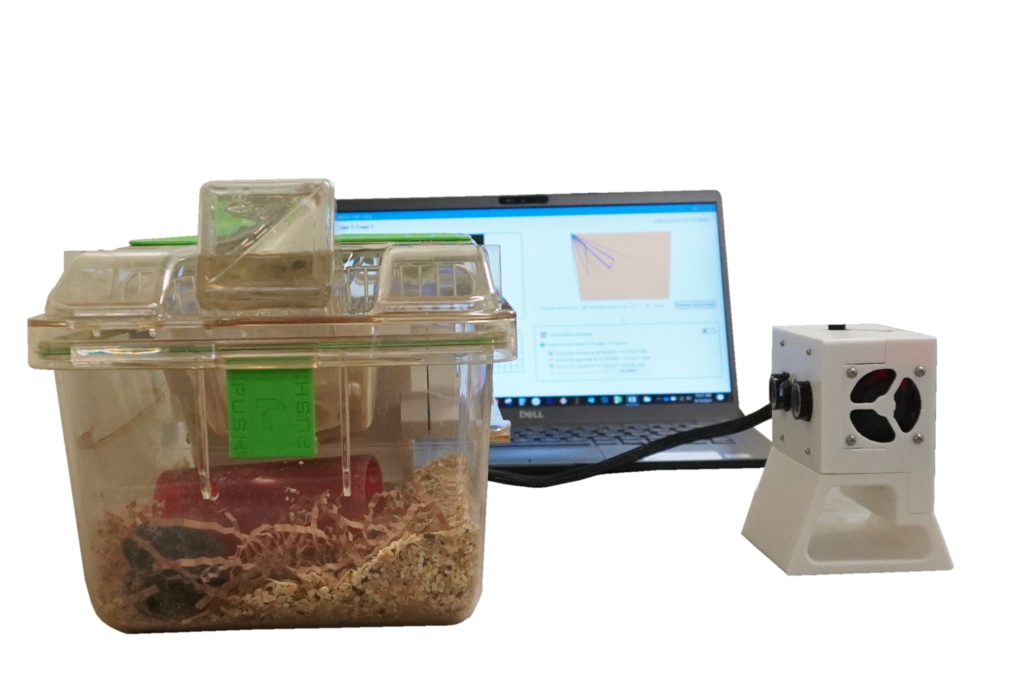
The present work introduces an automated and smart system (named CageView) used to monitor a mouse, detect motion, and control access to food in accordance with experimental schedules. In particular, CageView is a programmable and remotely operable system such that (i) an experimenter at a remote workstation may set up a feeding/fasting schedule that allows feeding/fasting without the requirement of the physical presence of a staff member, (ii) the experimenter can control access to food in real time regardless of the pre-set schedule; (iii) the experimenter has real-time access to a live video feed to assess the mouse; (iv) an artificial intelligence system tracks the mouse’s location and physical activity and (v) a record is kept of activity which can be displayed as a 2D representation of mouse movement or a histogram showing mouse movement in 15 minute blocks for the duration of the experiment.Click here to download the document.
This invention relates to an automated and smart system that has one or more vision units, one or more feeding mechanisms and a software. The vision unit has a capturing system that may work with a camera or a sensing system; a light detection system; a video streaming system; and a data storage unit. The feeding mechanism consists of a programmable and controllable food access linkage that moves along different axes. The software includes a module for scheduled feeding and fasting scenarios; a module for manual food control by an experimenter; a program window for real-time monitoring of the animal, an artificial intelligence or neural network system for detecting the animal; a module to control the water dispensing, a module to control all mechanical and electrical components of the invention that controls the conditions of the experiment; and a panel for presenting interactive statistical and graphical information on the animal’s activities. The vision unit and the feeding mechanism may be used separately or together depending on the needs of the experimenter. In addition to the vision unit and the feeding mechanism, other compartments such as an automatic water dispenser may be added to the automated and smart system. The automated and smart system could operate through a local, wired, wireless, or cloud-based network.


